
Free skill for ChatGPT and Claude

Marketing your customers read to the end.

AI drafts sound like AI: the launch post is a feature list, the email reads like a template, and customers scroll past both. The Writer is one free file you add to ChatGPT or Claude. From then on, "write the launch post" or "draft an email to all our customers" comes back sounding like a professional author wrote it, and your customers read it to the end.

Download The Writer

Three plain-text files. Free, no signup, works in ChatGPT and Claude.

The download is free. What we sell is at the bottom of the page, with prices.

The same announcement, written twice.

Two copies of the same AI got the same product brief and the same request: write the LinkedIn post announcing the feature. One had The Writer. Both posts are below, whole and unedited.

Without The Writer

Kestrel CRM

Company page post

Falcon Query Engine ships with Kestrel 8.2 on September 2.

If your workspace holds millions of contacts, you know the failure mode. You change one filter on an account list and then you wait. A dashboard that takes eleven seconds isn't a dashboard anymore. It's a report you open once a week, if that.

Falcon changes what happens underneath. Instead of scanning the full table on every load, Kestrel now maintains rollups incrementally in a columnar cache. When a record changes, the affected rollups update within five seconds, and your dashboards and list views read precomputed deltas rather than recalculating aggregates from scratch.

Internal benchmark on our reference organization (2.4M contact records, 90 days of activity history, 62 custom fields):

Dashboard load, p50: 6.2s → 210ms Dashboard load, p95: 11.4s → 480ms Dashboard timeout rate: 3.1% → 0.02% Saved-report CSV export: 84s → 9s Mobile cold open: 14s → 1.9s Account list filter change: 4.8s → 130ms

Nothing to install, no data migration, no pricing change. Existing dashboards, saved reports, and API report endpoints pick up the new engine on their own.

Where it doesn't help yet, since you'll find this out anyway:

• Custom SQL blocks in dashboards bypass the cache and run at their previous speed. • Workspaces over 5M records need a one-time index build that can take up to 40 minutes. It runs in the background, and dashboards stay available on the old path until it finishes. • Custom-object rollups are slower to refresh than standard objects, p95 around 8 seconds against the 5-second guarantee we hold for standard objects.

On by default for Growth and Enterprise at GA. Starter is next in line, and we'll name a date once we're confident in it.

#CRM #ProductUpdate #DataEngineering

With The Writer

Kestrel CRM

Company page post

Eleven seconds.

That was the p95 load time on a Kestrel dashboard in a workspace with 2.4 million contacts. Long enough that people stopped opening dashboards in front of a customer and started exporting the night before instead. Three loads in a hundred never finished at all. Our support queue carried roughly 240 of those complaints a month.

The data was fine. The counting was the problem. Every dashboard load and every filter change on an account list scanned the full table from the top, recomputing numbers that had not moved since the last time anyone looked.

Kestrel 8.2 ships the Falcon Query Engine, and it stops doing that. Rollups are maintained incrementally against a columnar cache. When a record changes, the rollups it touches update within five seconds, so a dashboard reads a precomputed delta instead of recalculating the world.

On our reference org (2.4M contacts, 90 days of activity history, 62 custom fields):

Dashboard p50 load: 6.2 s → 210 ms Dashboard p95 load: 11.4 s → 480 ms Timeout rate: 3.1% → 0.02% Saved-report CSV export: 84 s → 9 s Mobile cold open: 14 s → 1.9 s Account list filter change: 4.8 s → 130 ms

Here is what those numbers buy. Someone in the room asks what the pipeline looks like for enterprise accounts in the Northeast. You change the filter while they are still talking, and the answer is on the screen before they finish the question. The report becomes something you interrogate live, at the speed of the conversation.

The honest limits: custom SQL blocks bypass the cache and run at the old speeds. Workspaces above 5 million records need up to 40 minutes for the first index build, which runs in the background while dashboards keep serving on the old path. Custom-object rollups currently sit at 8 seconds p95 rather than under 5.

Falcon is on by default for Growth and Enterprise at 8.2 GA on September 2. Nothing to migrate and nothing to switch on. Pricing is unchanged. Existing dashboards, saved reports, and API report endpoints pick up the engine on their own. Starter plans follow in 8.3.

Eleven seconds used to decide whether the question got asked out loud. Now it does not come up.

Same model on both sides, the same brief, the same request, one pass each. We read both transcripts afterward: the agent without the skill opened the brief and wrote its post; the agent with it read The Writer first, wrote, and checked its own draft against the guide before saving. Neither got help from anywhere else.Kestrel is a fictional company invented for this test, so no real customer data appears on either side. Read the two openings against each other: one starts with the product name, the other starts with the eleven seconds a customer sat waiting. Then read the two endings.

When to use this

Reach for it when a customer, a prospect, or a client has to read the thing and act on it without you in the room. It works from whatever is real: a launch, a result, a number worth reporting, a win a client paid for. It writes short fiction too, and the download ships a story to prove it, but the day job is the writing that sells.

Use it for

Launch posts and announcements
The release lands on what your customer can now do, with the measured numbers underneath as proof. The two posts above are this exact job.
Sales emails and follow-ups
Written to earn the reply: one concrete detail from the buyer's world up front, one clear next step at the end, and nothing that reads like a template.
Case studies and customer stories
The before is a real Tuesday, the after is a decision your customer made differently. Buyers recognize themselves, and the story sells before the call.
Client updates and reports
The month reads as one story with a cause running through it, so the client remembers exactly what they paid for.
Newsletters and founder posts
Reads like a letter with a point, instead of a list of links. Readers finish it, then forward it.

Not for

Spec sheets and price lists
People search those. A narrative buries the line they came for.
A quick status answer
If one sentence answers it, send the one sentence.

How to use this

Install once. Then ask in plain words.

"Write a LinkedIn post about the new feature, using The Writer." "Draft an email that goes out to all our customers." "Make this readable." That is the whole workflow.

ChatGPT

Skills are live on Business, Enterprise, Edu and Healthcare plans; an admin may need to switch them on. On Plus or Free, use a project instead: paste the guide into its instructions and add the two example files. Same result.

  1. 01

    Open the Skills page: pick Plugins in the sidebar and switch to the Skills tab, or go straight to chatgpt.com/skills.

    Plugins → Skills
  2. 02

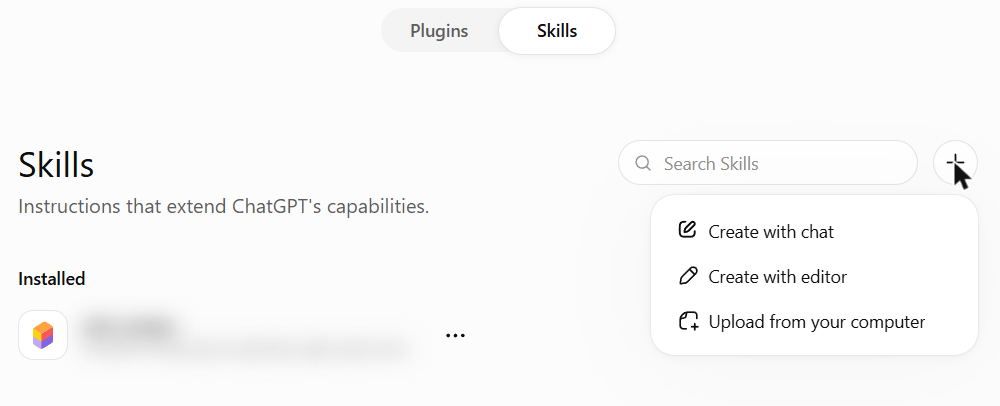
    Click the plus button, then upload from your computer.

    + → Upload from your computerThe ChatGPT Skills page with the add menu open: Create with chat, Create with editor, and Upload from your computer.
  3. 03

    Select the-writer-skill.zip exactly as downloaded.

    ChatGPT expects a zip holding one folder with SKILL.md inside. That is exactly what the download is.

  4. 04

    Ask for the writing in any chat.

Claude (web or desktop)

Works on Free, Pro, Max, Team and Enterprise plans.

  1. 01

    In settings, open Capabilities and check that cloud code execution is on. Skills need it.

    Settings → Capabilities → Cloud code execution and file creationThe Claude capabilities setting named Cloud code execution and file creation, switched on. Its description ends: Required for skills.
  2. 02

    In the sidebar, click Customize. It opens on your Skills list.

    Customize → Skills
  3. 03

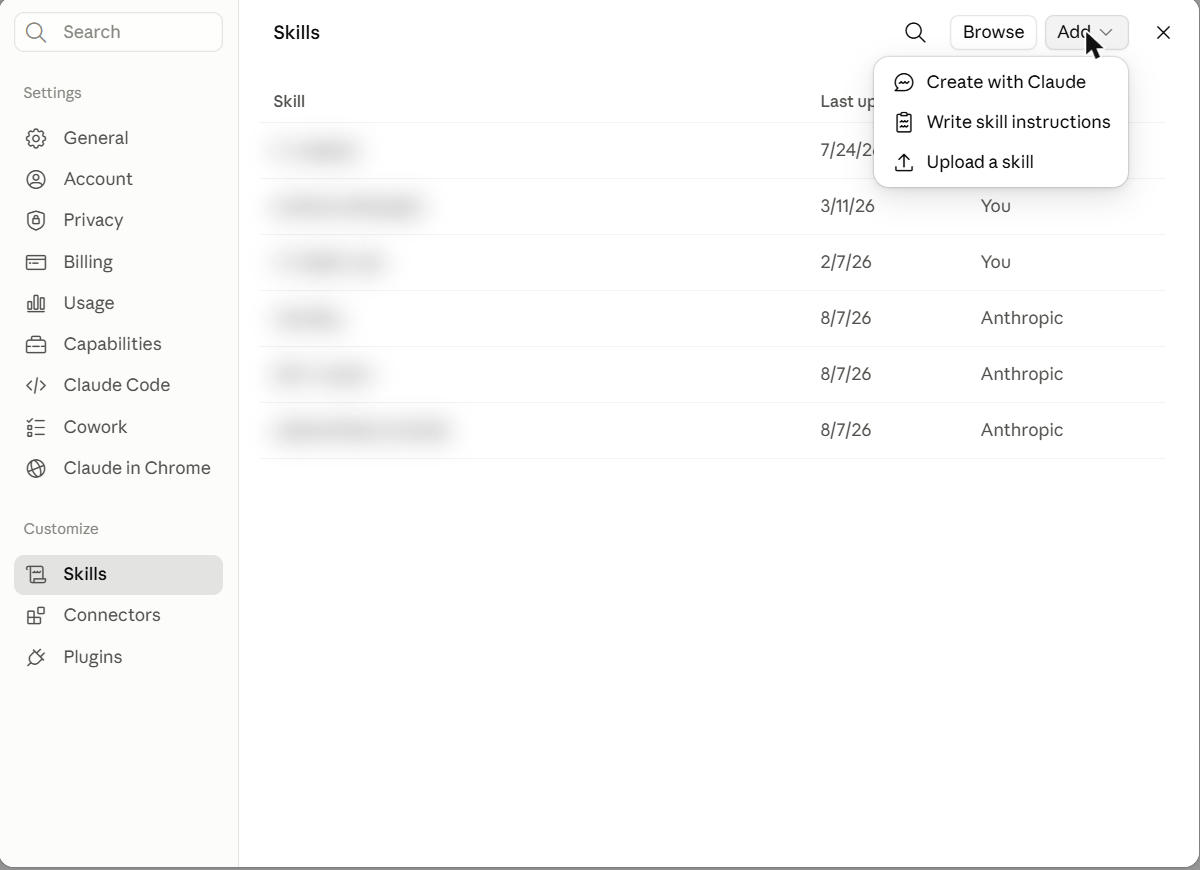
    Click Add, then Upload a skill.

    Add → Upload a skillThe Claude Skills page with the Add menu open: Create with Claude, Write skill instructions, and Upload a skill.
  4. 04

    Select the-writer-skill.zip.

    Upload the zip exactly as downloaded. Do not unzip it first.

  5. 05

    Start a new chat and ask for the writing.

On Claude Code? Unzip the download into your skills folder (~/.claude/skills) and it loads on the spot.

The paid part

Here is what we sell.

Everything above this line is free and stays free. Below it is what we sell. The prices are the prices, and the two subscriptions carry 30 days money back on the first month.

The readiness audit, done for you

Send us access to your repo. We run the nine-lane review, change nothing, and hand back the report with a 30 minute call on the three gaps to close first.

Who it is for
You have a product you charge for, or want to, and you would rather read the verdict than run the agents.
Price
$349One week
What you get
  • The report at docs/commercial-readiness.md: a verdict, a scorecard, every gap with the file to open and how to verify it
  • Legal, security, billing, support, marketing, operations and the rest, checked at once
  • A 30 minute call on the three gaps to close first
  • Nothing in your repo changed. The workflow prompt is yours to run afterward
The facts
The review is the one in the video. On our own product it found 87 gaps. The overnight run that followed was 148 commits and one pull request.
Our guarantee
If the review finds no gap worth your time, you pay nothing.

The first run, with Jason

We run the review on your repo together, on a call, and you leave with the report in your repo and the three gaps to close first.

Who it is for
You have the kit and a repo, and you would rather do the first run with someone who has done it.
Price
$9960 minutes
What you get
  • The review running on your machine, in your Claude Code
  • The verdict read together, and the three gaps picked
  • The workflow prompt set up so you can run it that night
  • The call recording
The facts
New. You would be one of the first. The run itself is the one in the video: 190 agents, 148 commits, one pull request.
Our guarantee
If the review will not run on your setup during the call, there is no charge.

Mica Social Media Analyzer

Your Instagram, answered by the ChatGPT or Claude you already use. Connect the account once, then ask in plain words what worked and what to post next.

Who it is for
You post on Instagram and you are done guessing from the Insights tab.
Price
$29/ month
What you get
  • Which Reels held attention, ranked, without opening Insights
  • Readings at 1, 24 and 72 hours after every post, so you see what happened while it was moving
  • Next captions written in the style of your most saved posts
  • Read only. It never posts or changes anything
The facts
7 days free with a card on file. About a dollar a day after that.
Our guarantee
30 days money back on the first month. Email guru@graniteai.co and we refund it.

Mica Social

An AI that writes, designs, checks and publishes a post to your Facebook and Instagram every day. You send a photo when you have one. It does the rest.

Who it is for
You know the feed should be alive every day and it is not.
Price
$49/ month
What you get
  • A finished post every day, with a photo made for it. Nothing to shoot
  • Timed to your local weather, season and county numbers
  • Five checks before anything publishes. No approvals, no calendar, no logins
  • Every photo you send becomes its own extra post
The facts
An agency running a daily feed bills $500 to $1,500 a month. 3 days free with a card on file.
Our guarantee
30 days money back on the first month. Email guru@graniteai.co and we refund it.

GraniteAI builds and runs AI systems for small and midsized businesses, out of Manchester, New Hampshire.

We wrote this for our own marketing.

Launch posts, client recaps, and outreach here all go through it, and the guide got sharp because the writing had to survive an owner who stops reading at the first dull paragraph. Take it, run it on your next launch, and cut whatever does not fit.

Who made this

GraniteAI builds and runs AI for small and midsized businesses, out of Manchester, New Hampshire. Follow-ups that stop slipping, a feed that stays alive, and a ChatGPT that knows the market a business actually works in. That last one is the Mica Intelligence Engine: an owner asks what to charge or which town to work next, and the answer arrives backed by verified facts about their own county and trade, each carrying a source and a date. See the engine

The next free file

The Writer settles how the post reads. What goes in it still has to come from your business, and the AI you are asking does not have those facts. Point us at your website and we email you a context kit that makes ChatGPT or Claude answer from your business instead of guessing about it. Free, and you can read every file before you use it.

If the business you write for is a local one, the daily post is its own job. Mica takes that end for trades like cleaning and roofing, drafting and publishing on a schedule, so the feed stays current through the months nobody has an hour to sit down and write. See Mica